
Men's Tennis "Rewind" 1999: Why I Believe in Miracles
Ahead of this year's Roland Garros, we at the Bleacher Report tennis community will be offering our "Rewind" series to commemorate the matches we remember best from the RG's illustrious history. Contributing later will be Long John Silver, Rohini Iyer, and possibly others. Stay tuned...
By mid-May of each year tennis is well-into its clay season and players are prepping for Roland Garros.
It was about this point in 1999 that Andre Agassi had just withdrawn from the World Team Cup with a shoulder injury and was listed as uncertain for jewel of the clay court season, the only major he’d never won.
TOP NEWS
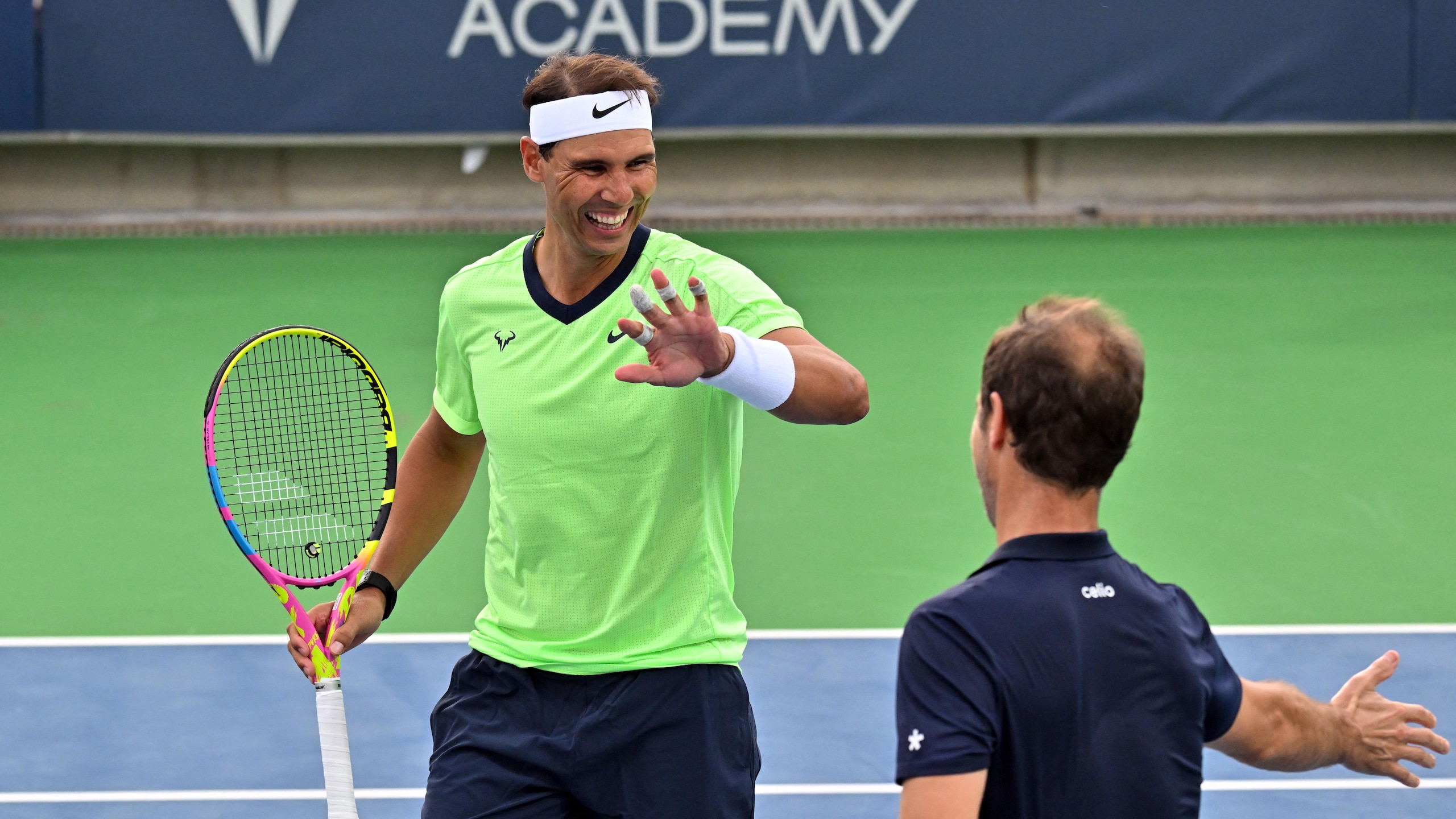
Rafa Playing Exhibition 🎾
.jpg?w=2560 "Seahawks Chiefs Football")
Chiefs, Steelers Eye WR Trades

J-Dub, Wallace May Miss Entire Season
At this point in his career, Agassi was still an underachiever. He’d won three major titles and spent much of 1995 at No. 1, but a defeat from Pete Sampras in that year’s U.S. Open had sent the game’s greatest service returner spiraling. After sinking to a career-nadir of No. 141 in 1997, he fought back in ’98, getting back into the top 10.
He’d only won minor events, though, and hadn’t been past the fourth round of a major since ’96. That winter, Agassi had slumped to another fourth-round defeat against Vince Spadea, a lesser-known American who played a less-accomplished version of Double-A’s game.
Soon after, he divorced his wife, Brooke Shields, then sustained his injury, seemingly leaving his career trapped in the second tier of the top 10.
It wasn’t just Agassi who was in trouble at the time, though; men’s tennis was struggling to stay relevant. While Agassi was out of sorts and Sampras was beginning his slow decline, the next generation of talent, Mark Philippoussis and Marcelo Rios in particular, weren’t breaking through at the majors.
This meant that slams were being won by players who failed to excite fans, such as Yevgeny Kafelnikov and Petr Korda. Other winners, like Carlos Moya and Patrick Rafter, were more likable but couldn’t sustain their results year-round.
There were virtually no mentions of tennis in the mainstream press in those days that didn’t involve discussions of what was “wrong” with the game.
Did it need wooden rackets again? Did it need plotlines like Martina Hingis’ remarks about Amelie Mauresmo’s sexual orientation? Or, was a fundamental change in the scoring or atmosphere required to make the game less, you know, tennis-like?
A few of us rejected all such ideas, believing that men’s tennis just needed the right man at the top.
The draw
Agassi ultimately took a chance on his shoulder and entered the event, but his draw was not promising. In the round one he drew Franco Squillari, an extremely tough dirtballer from Argentina whose left-handed, heavy-spinning style of play placed him somewhere between Thomas Muster and Rafael Nadal on the evolutionary graph.
Squillari won the first set, but Agassi toughed out the next two, both by seven games to five. He took the fourth set 6-3, ending the match by hitting three consecutive aces. Agassi fans were happy that he’d gotten at least one good win.
In round two, he faced the undersized but scrappy French retriever Arnaud Clement, an eventual Australian Open finalist. Backed by the home crowd, Clement led Agassi two sets to one and, in set four, was two points from victory.
He failed to seal the deal, though, and Double-A rolled through the final set 6-0. Agassi fans were pleased that he was not fading against tough competition.
In round three, he met fellow American Chris Woodruff, who’d beaten Agassi at the ’96 RG. In round two Woodruff had taken out the rising Ecuadorian Nicolas Lapentti, who’d himself stopped Muster in round one.
Woodruff’s good form was not enough against Agassi, who won in straight sets. As the second week began, Agassi fans were happy just to have him in the mix, and knew he’d be tough against any opponent.
This realization was well-timed, because in the round of 16 Agassi’s opponent would be defending champion Moya, who’d reached the world No. 1 ranking in that spring. Moya’s effortless movement and booming forehand would make him a threat at many RGs to come, and they propelled him to a first-set victory and two-break advantage in set two.
Down 1-4, Agassi later said it was at this point that he began to prioritize aggression over caution, determined that if he lost he’d go down trying to dictate play.
Perhaps the change in tactics rattled Moya, as Agassi won six of the next seven games and leveled the match. After winning a hard-fought set three, Agassi ran away with the fourth, surrendering only one game.
Agassi fans were now very happy, as he was looking like a very credible threat to win the event. In doing so, he’d become the first man to have won all four majors at some point in his career in exactly 30 years, and the first to do so since hard courts were adapted at two of the Grand Slam events.
In the quarters, his opponent was Marcelo Filipini of Uruguay, a tour veteran with classic, economical strokes and absolutely no chance against Double-A. The American lost all of four games in what was, in terms of minutes, the briefest RG quarterfinal in history.
Just as significant for his chances was what happened to his competition in the same round.
On Agassi’s side of the draw, Slovakian Dominik Hrbaty took out former world No. 1 Rios, whom Agassi had never beaten. On the other, Ukrainian Andrei Medvedev ousted ’97 RG champion Gustavo Kuerten, who some had picked to win the event.
Meanwhile, ’98 RG finalist Alex Corretja was ailing, and went to his execution against Brazilian Fernando Meligeni.
In the course of a round, Agassi had gone from an outside chance of winning to being the favorite. Having fought through the brutal draw he’d been handed in the first week, the second was now parting for him like the Red Sea before a bearded Charlton Heston.
The Paris draw was opening up for him as it never had for Sampras, and to date never has for Roger Federer.
Agassi fans now had cause for excitement, as the right man, perhaps the only player of the ‘90s that non-tennis fans could pick out of a lineup, was two wins from a career-defining victory. They also had cause for concern, though: Roland Garros had long been the oasis in Agassi’s desert, never truly as close as it appeared.
In his first major final in 1990, Agassi had been favored to beat the Ecuadorian veteran Andrés Gómez but lost in four sets. The next year, Double-A had won the first set against Jim Courier before a rain delay, after which Courier recalibrated and outlasted his more famous compatriot.
Double-A had recovered from those setbacks, but would a third disappointment kill his career?
Tough conditions
Hrbaty provided tough, but manageable opposition for Agassi in the first two sets of their semi, with the American winning 6-4, 7-6. In the third, the Slovak found another gear, winning 6-3, breaking a second time to close it out.
As the fourth began with the momentum on Hrbaty’s side, witnesses said that Agassi looked to the graying skies as if to say, “You owe me for Courier.”
Perhaps someone up there agreed, because soon the rains came, washing away the remnants of Friday’s schedule. The next day they returned, and on the same day Agassi’s future wife Steffi Graf won her last major, he finished Hrbaty 6-4, setting up a clash with Medvedev.
Though considered a dangerous player since the early part of the decade, the Ukrainian had struggled in the latter part of the ‘90s. His tremendous play at this event, stopping not only Kuerten but Sampras along the way, was nearly as surprising as Agassi’s.
Though nearly all outside of the former Soviet republic were pulling for the American, Medvedev faced lower expectations, which may have helped him start stronger.
The weather of Sunday, June 7 was characterized by strong, gusty winds that seriously hindered Agassi, whose game depended on consistency and accuracy in his groundstrokes.
Medvedev, five inches taller and 20 pounds bigger than Double-A, simply muscled the ball back into play, and his towering serve won him a greater share of easy points.
Agassi, lacking a great serve, volley, or gazelle-like movement, is the type of player who needs the groundstrokes to fire, or the result can be unpleasant. Medvedev won the first two sets 6-1, 6-2, and it appeared this RG campaign was headed for a more disastrous end than in his previous disappointments.
When he held even and then broke Medvedev in the fourth, many Agassi fans were just hoping he could make the final score respectable. Capturing the set 6-4, however, made him into a totally different player.
As stated earlier, Agassi’s game depends heavily on groundstrokes; fortunately for him and his fans, they’re possibly the best groundies ever struck on a tennis court.
Sampras and later Federer were able to score wins over him through their superior serving, volleying, and speed; were tennis reduced to the core skill of simply hitting the ball as hard, accurately and consistently as possible, though, perhaps only Jimmy Connors and Marat Safin would be able to compete with Double-A.
And thanks to his intense off-court training with Gil Reyes, Agassi could now hit those groundies all day.
In set four Agassi was inside the baseline, picking up Medvedev’s shots right after they bounced and rifling them through the court, sending the big Ukrainian scrambling on the defensive. Medvedev’s serving and penetrating forehand kept the score close, but Agassi broke to win the set 6-3.
Entering the fifth, the score had been evened, but in all other senses Agassi was ahead. Soon he had broken again, and Medvedev was forced to save several match points at 3-5. The American would have to serve out the match.
Agassi’s high-bouncing kick serve was typically not employed to win points by itself, but rather to set up his groundstrokes and allow him to tire his opponents.
By the end of this match, it had done its job well, as Medvedev struggled to get it back into play. Agassi quickly raced to a 40-15 lead, one point from the career Grand Slam, and one point from never being an underachiever again.
He kicked his serve out wide to the forehand of Medvedev, who stretched to get his racket on it but sent the return well-beyond the baseline.
As the return sailed past, Agassi raised his arms, tears saturated his eyes, and the racket fell from his hand. He had the French championships he was missing, and men’s tennis had the champion it needed.
The resurgence
Agassi’s victory gave temporary inspiration to his compatriots: Jim Courier fought to a fourth-round result at Wimbledon, his worst surface; Todd Martin reached his second major final at the U.S. Open; Pete Sampras went on a tear, winning four events in a row, including his sixth Wimbledon.
But Agassi was permanently changed by the result: He reached his second Wimbledon final, won his second U.S. Open, and finished the year ranked No. 1—a first for him.
He made the cover of Sports Illustrated and soon even non-tennis fans could be heard asking, “How’s Agassi doing?” As the decade ended, televised tennis in the United States reached its highest ratings in years.
Double-A would add three more Australian Opens in the decade to come, bringing his major tally to eight and tying him with fellow baseline luminaries Connors and Ivan Lendl.
In addition to the career slam, Agassi again reached No. 1 in 2003 at nearly 33, making him the oldest to hold that designation. His total of 17 Masters Series wins is the current record, though Rafael Nadal may eclipse it this year.
Some wish Agassi had been more dedicated in his youth, rather than boasting of his cheeseburger diet, lauding image over substance, and going into funks after losses such as the 1995 U.S. Open final.
Not me.
Agassi’s resurgence was well-timed, as Sampras’ returns were diminishing, and the Reign of Fed was still years away, giving Double-A a gap to exploit. His absences from the game in the ‘90s meant he still had much to offer in this decade, leading to memorable runs in the ‘05 and ’06 U.S. Opens.
Above all, I wouldn’t trade his 1999 Roland Garros campaign for any other storyline.
It’s been almost 10 years ago since Agassi transitioned from underachiever to all-time great in a single French championship. Going into this year’s event, Rafael Nadal’s win appears all but certain. The odds certainly favor him, but after the ’99 RG, one should believe anything is possible.
Thanks to that tournament, this fan still believes in miracles.





.jpg?w=2560 "Raiders Sticking with Cousins")